Forget those 16-type quizzes you took at 2am for fun.
The Big Five is what psychologists actually use. Not because it’s trendy, but because decades of research keep landing on the same five dimensions, across cultures, languages, and age groups.
Here’s what they are, where they came from, and why they hold up better than almost anything else in personality science.
What the Big Five actually is
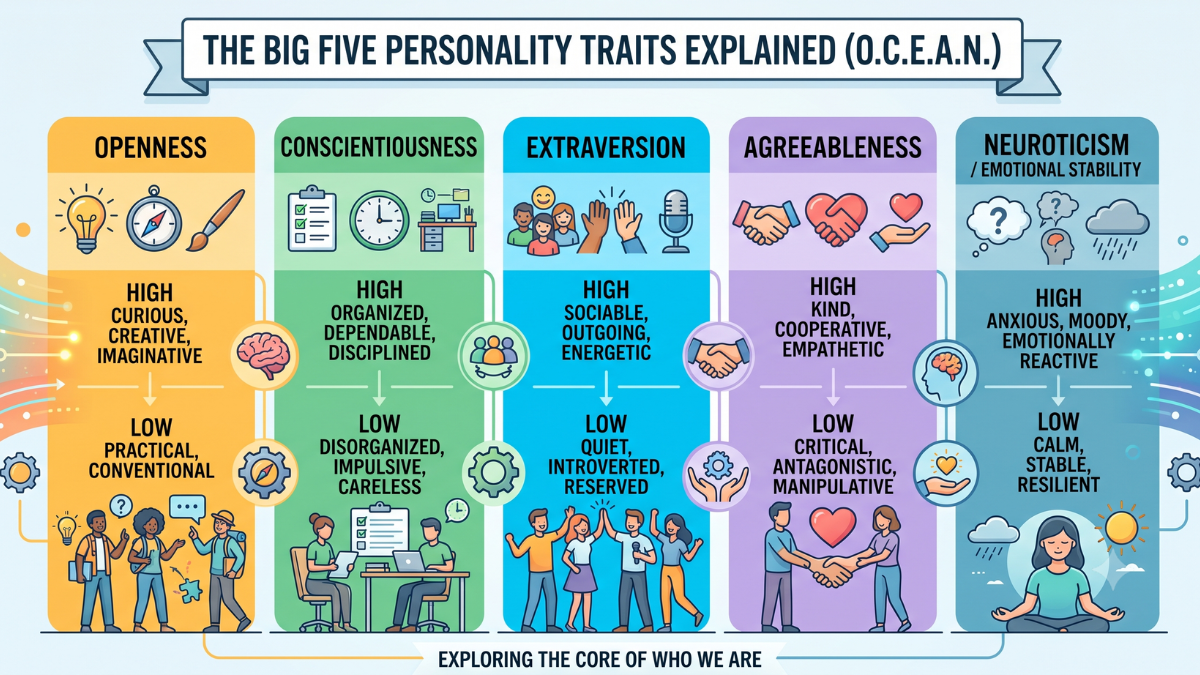
The Big Five, sometimes called OCEAN or the Five-Factor Model, breaks personality into 5 broad traits.
Openness. Conscientiousness. Extraversion. Agreeableness. Neuroticism.
Each one is a spectrum, not a category. You’re not “an introvert” or “an extrovert.” You land somewhere on a scale, and that spot can shift a bit depending on context and age.
No trait is good or bad on its own. High conscientiousness helps you hit deadlines. Too much of it can tip into rigidity. Low neuroticism means you stay calm under pressure. Too little can mean you miss real warning signs.
Where this model came from
The Big Five wasn’t invented by one person in a lab. It emerged from decades of a method called the lexical approach.
The idea, first floated in the 1930s by Gordon Allport and Henry Odbert, was simple. If a personality trait matters enough for humans to notice, there’s probably a word for it in every language. So researchers combed dictionaries for personality-related words. English alone had thousands.
Through the 1960s to 1980s, researchers like Ernest Tupes, Raymond Christal, and later Lewis Goldberg ran that giant word list through statistical analysis. Words like “organized,” “reliable,” and “disciplined” kept clustering together. So did “outgoing,” “talkative,” and “energetic.”
Five clusters kept showing up, over and over, in different datasets, in different countries, and in different decades. That consistency is why the model stuck. Paul Costa and Robert McCrae later built the most widely used questionnaire for it, the NEO-PI.
The five traits, one by one
Openness to experience. Curiosity, imagination, and comfort with new ideas. High scorers like abstract thinking, art, novelty. Low scorers prefer routine and the practical over the theoretical. This is the trait most linked to creativity and to political and aesthetic preferences.
Conscientiousness. Organization, discipline, and follow-through. High scorers plan ahead and finish what they start. Low scorers are more spontaneous, sometimes at the cost of missed deadlines. Of all five traits, conscientiousness has the strongest link to job performance and even to how long people live.
Extraversion. Sociability, assertiveness, and energy from other people. High scorers recharge at parties. Low scorers, often mislabeled as shy, usually just recharge alone. Introversion isn’t a deficiency. It’s a different battery type.
Agreeableness. Warmth, cooperation, and trust in others. High scorers are easy to work with and quick to forgive. Low scorers are more skeptical, more competitive, and sometimes blunt to a fault. Low agreeableness isn’t the same as being a bad person. Some of the most effective negotiators score low here.
Neuroticism. Emotional stability, or the lack of it. High scorers feel anxiety, sadness, and mood swings more intensely and more often. Low scorers stay level even under stress. This is the trait most tied to mental health risk and the one most people wish they could dial down.
How psychologists actually measure it
Most Big Five assessments use self-report questionnaires. You rate statements like “I see myself as someone who worries a lot” on a scale from strongly disagree to strongly agree.
The NEO-PI-R is the gold standard, with 240 questions. That’s a lot for casual use, so shorter versions exist too. The Big Five Inventory (BFI) runs 44 items. The Ten-Item Personality Inventory (TIPI) strips it down to just 10, useful for research but rougher on precision.
None of these are perfect. People aren’t always honest with themselves, let alone with a survey. But compared to something like Myers-Briggs, the Big Five has real predictive power backed by peer-reviewed research, not marketing.
Why it beats Myers-Briggs
Myers-Briggs sorts people into 16 fixed boxes: INTJ, ESFP, and so on. It’s fun. It’s also built on Carl Jung’s theories from the 1920s, which were philosophy, not tested science.
The math doesn’t hold up well either. Studies show that a large share of people retested weeks later land in a different type entirely, sometimes close to half. A model that flips your entire category based on your mood that day isn’t measuring something stable.
The Big Five doesn’t have that problem. It’s dimensional, not boxed. And it correlates with real outcomes: job performance, relationship satisfaction, and even physical health. That’s the difference between a personality tool used in HR departments for fun team-building exercises and one used in actual clinical and organizational research.
What your scores can and can’t tell you
Knowing you score high in neuroticism doesn’t mean you’re broken. It means you might benefit from stress management tools earlier than someone who scores low. Knowing you’re low in agreeableness doesn’t make you a jerk. It might mean you’re better suited to roles that need tough negotiation or hard feedback.
Traits aren’t destiny. They shift some with age. Most people get a bit more conscientious and agreeable and a bit less neurotic as they move through their 30s and 40s. Life experience does that.
The Big Five also isn’t the whole story. It says nothing about your values, your intelligence, or your specific fears and dreams. It’s a map of broad tendencies, not a full biography.
Where to take a real test
If you want an actual research-grade version, look for the Big Five Inventory or the IPIP-NEO, both free and used in academic studies. Skip the ad-heavy quiz sites that promise a fun animal result at the end. Those are entertainment, not psychology.
The bottom line
Five traits sound too simple to capture something as messy as a personality. But that’s kind of the point.
The model doesn’t try to sort you into a type. It just describes where you sit on 5 honest scales, built from what actually held up across thousands of studies. That’s rarer in psychology than you’d think.