You can’t remember what you had for lunch on a random Tuesday 3 weeks ago. But you can still recite the lyrics to a song you haven’t heard in 10 years.
That’s not a glitch. That’s how memory is built to work.
Here’s what’s actually happening in your brain when you remember something, why you forget so much, and why your memories aren’t as reliable as they feel.
Memory isn’t one thing
People talk about “memory” like it’s a single filing cabinet. It’s not.
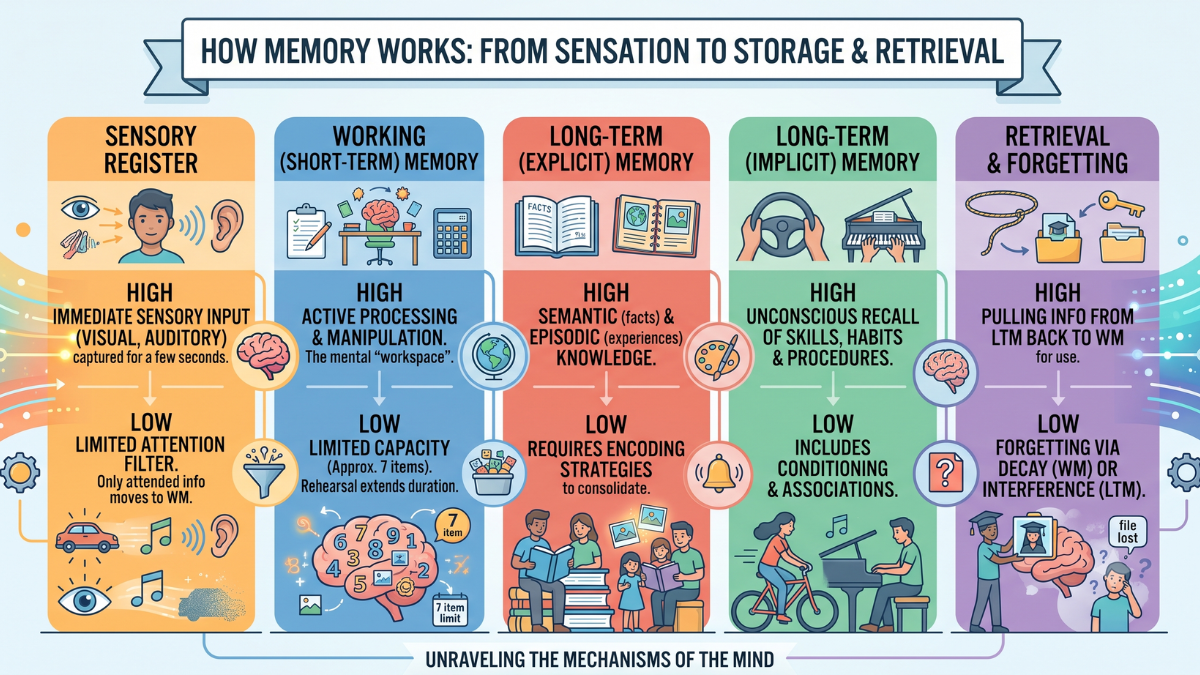
Psychologists break it into stages and types. The stages are encoding, storage, and retrieval. Encoding is getting information in. Storage is holding onto it. Retrieval is pulling it back out later. A breakdown at any stage means you “forget,” even though the failure might have happened long before you tried to recall anything.
Then there are the types. Short-term memory holds a small amount of information for a short window, maybe 20 to 30 seconds without rehearsal. Working memory is a more active version of that, the mental scratchpad you use to hold a phone number while you dial it. Long-term memory is the big archive, everything from your childhood address to how to ride a bike.
Long-term memory splits further. Explicit memory covers facts and events you can consciously describe. Implicit memory covers skills and habits you perform without thinking, like typing or walking.
How something becomes a long-term memory
A big part of this happens in a small seahorse-shaped structure called the hippocampus.
When something happens to you, neurons fire in a specific pattern. If that pattern gets reinforced, through repetition, emotional weight, or attention, the connections between those neurons strengthen. Neuroscientists call this process long-term potentiation. It’s basically the brain wiring itself a shortcut for next time.
The hippocampus acts like a save button. It helps convert short-term experience into a longer-term file, then gradually hands that file off to the cortex for storage. This handoff, called consolidation, isn’t instant. It happens over hours, days, and sometimes years. That’s part of why sleep matters so much for memory. A lot of consolidation happens while you’re out cold.
Damage to the hippocampus doesn’t erase old memories. It stops new ones from forming. That’s the condition made famous by the patient known as H.M., who had his hippocampus removed in 1953 to treat epilepsy and afterward couldn’t form new long-term memories at all. He could still learn new physical skills, just with zero memory of ever practicing them. That case alone reshaped how psychologists understood memory for decades.
Why you forget almost everything
Forgetting isn’t really a failure. It’s the system working as designed.
Your brain can’t keep everything. So it prioritizes. Emotional events, repeated information, and anything tied to your goals get preferential treatment. A forgettable Tuesday lunch gets none of that, so it fades fast.
Hermann Ebbinghaus mapped this out in the 1880s with his forgetting curve. He memorized nonsense syllables and tested his own recall over time. Without any review, he lost about 50% of new information within an hour, and closer to 70% within a day. Spaced repetition, reviewing material at increasing intervals, is one of the few things proven to fight that curve. It’s why flashcard apps like Anki work.
Interference plays a role too. New information can crowd out old, and old habits can bleed into new learning. That’s why you sometimes type your old phone number by accident years after switching.
Your memory is editing itself right now
Here’s the part that surprises people most. Memory isn’t a recording. It’s a reconstruction.
Every time you recall something, your brain rebuilds it from fragments, and that rebuilt version gets re-stored, sometimes with small changes. Elizabeth Loftus proved this decades ago with her research on false memories. In one famous study, she showed that simply changing the wording of a question, asking how fast cars were going when they “smashed” versus “hit,” changed how people remembered a car accident they’d watched on video. Some participants even reported seeing broken glass that was never in the footage.
This is also how eyewitness testimony gets it wrong so often. Confidence in a memory has almost no relationship to its accuracy. A person can be completely certain and completely wrong at the same time.
Why some memories feel so vivid
Flashbulb memories are the vivid ones, the “I remember exactly where I was” kind. A national tragedy. A personal shock. These feel unusually sharp and permanent.
Research shows they aren’t actually more accurate than ordinary memories. They just feel more accurate. The emotional intensity of the moment tricks your brain into trusting the memory more, even as small details quietly shift over the years, same as any other memory.
Practical takeaways
A few things fall out of all this that are actually useful.
Repetition beats intensity for studying. Cramming feels productive, but spaced review over days beats one long session every time.
Sleep isn’t optional if you want something to stick. Pulling an all-nighter to study undercuts the very process that would have locked the material in.
Be skeptical of your own certainty. If you’re sure you remember something exactly right, that confidence alone isn’t proof. Memory reconstructs, and reconstruction leaves room for error, even in memories that feel airtight.
The bottom line
Memory isn’t a hard drive. It’s more like a story your brain keeps rewriting every time you tell it.
Useful, mostly reliable, occasionally embarrassing when it’s wrong with total confidence. Knowing how the system actually works won’t make you remember more. But it might make you trust the gaps a little less.