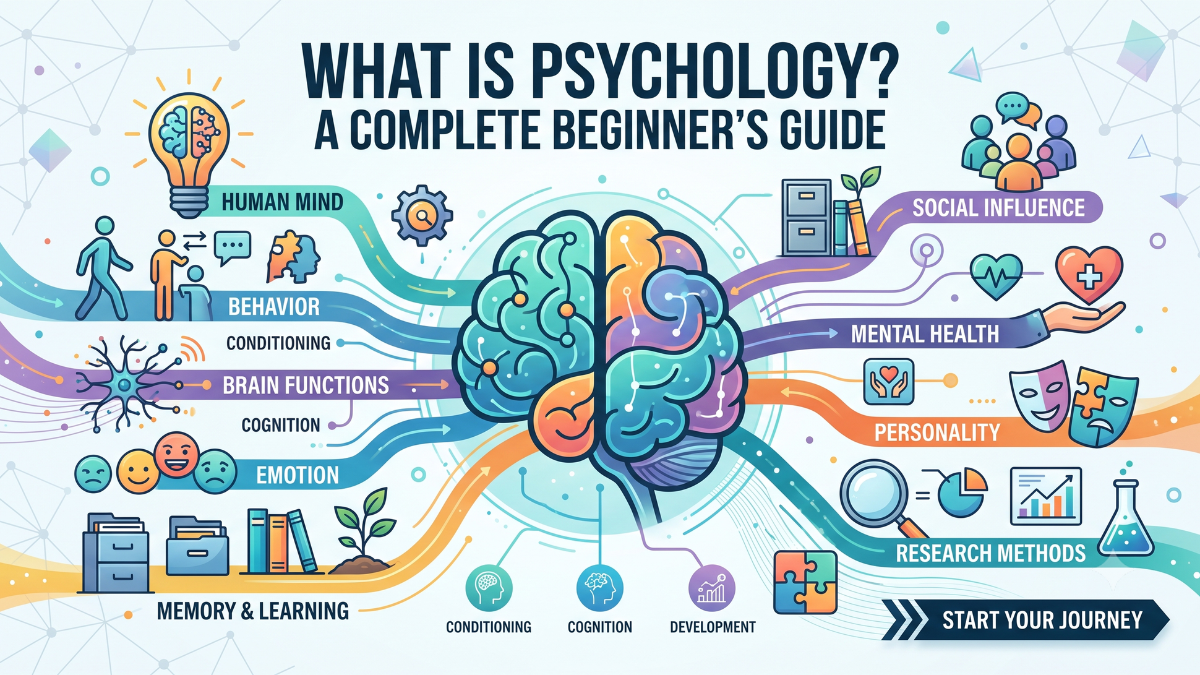
Psychology is the study of mind and behavior. That’s the textbook line.
But it doesn’t explain why you replay an awkward conversation at 2am. Or why a stranger’s smile can change your whole mood. Psychology tries to answer questions like that with evidence instead of guesswork.
Here’s what it actually covers, how it got here, and where to start if you want to learn more.
The short definition
Psychology studies how people think, feel, and act. And why?
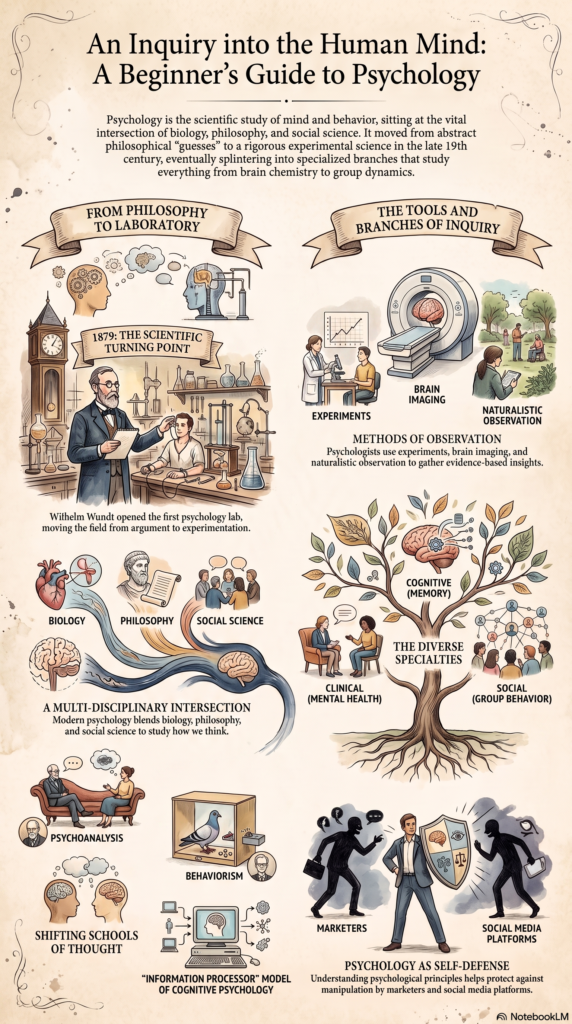
It sits at the intersection of biology, philosophy, and social science. A neuroscientist studying dopamine and a therapist listening to a client are both doing psychology. So is a researcher running a memory experiment on 200 college students.
The field is huge. Too huge for one clean definition to cover.
A quick history
Psychology wasn’t always a science.
For most of human history, questions about the mind belonged to philosophy. Plato wondered where knowledge came from. Aristotle wrote about memory and dreams. These were smart guesses, not experiments.
That changed in 1879. Wilhelm Wundt opened the first psychology lab in Leipzig, Germany. He measured reaction times. He timed how fast people noticed a sound after hearing it. Simple stuff by today’s standards. But it turned psychology into something you could test, not just argue about.
From there, the field splintered fast.
Freud showed up with psychoanalysis and the unconscious mind. Behaviorists like B.F. Skinner said, “Forget the unconscious, just study what you can observe: behavior.” Then cognitive psychologists in the 1950s and 60s pushed back on that too, arguing the mind works like an information processor and you can study thoughts scientifically, not just actions.
Each school thought the last one got it wrong. Each one was partly right.
The main branches
Modern psychology breaks into specialties. Here are the ones you’ll run into most.
Clinical psychology. Diagnosing and treating mental health conditions. Depression, anxiety, and PTSD. This is what most people picture when they hear “psychologist.”
Cognitive psychology. How we think, remember, and solve problems. Why do you forget where you put your keys but never forget a song from high school?
Developmental psychology. How people change across a lifetime. A 2-year-old’s brain works differently than a 40-year-old’s. This field maps that.
Social psychology. How other people shape your behavior. Why do you act differently in a group than alone? Why peer pressure works even on adults.
Biological psychology. The brain and nervous system side of things. Neurons, hormones, and genetics.
Industrial-organizational psychology. Psychology applied to workplaces. Hiring, motivation, and team performance.
There are more. Forensic psychology, sports psychology, and health psychology. Almost any human activity has a psychology subfield attached to it by now.
How psychologists actually study the mind
You can’t crack open someone’s skull and watch a thought happen. So the field relies on a few core methods.
Experiments. Change one thing, and measure what happens. Classic science.
Surveys and questionnaires. Ask people directly. Cheap and fast, but people don’t always answer honestly, even to themselves.
Case studies. Deep dive into one person or one small group. Freud built most of his theories this way. Useful for rare conditions, hard to generalize from.
Brain imaging. fMRI and EEG scans show which brain regions light up during a task. This is where biological and cognitive psychology overlap most.
Naturalistic observation. Just watch people in their normal environment without interfering. A researcher watching kids on a playground, for example.
No single method gives the full picture. Good psychological research usually stacks a few of these together.
Common myths worth clearing up
Psychology carries a lot of baggage from pop culture. Some quick corrections.
Myth: We only use 10% of our brains. Wrong. Brain scans show we use nearly all of it, just not all at once.
Myth: Psychologists can read your mind. No. They read behavior, and even that takes years of training to interpret well.
Myth: Therapy is just talking about your feelings. Sometimes. But a lot of modern therapy, like cognitive behavioral therapy, is structured, goal-driven work. Homework included.
Myth: Personality types like Myers-Briggs are backed by hard science. They’re popular, but most academic psychologists consider the evidence for them weak. The Big Five personality traits have far more research support.
Why any of this matters
Psychology isn’t just for people who want to become therapists.
It shapes how ads get designed. How your phone’s notifications are built to pull you back in. How teachers structure a lesson so it actually sticks. How doctors talk to patients about scary diagnoses.
If you’ve ever wondered why you procrastinate even when you know better, or why a habit is so hard to break, psychology has real, tested answers. Not always satisfying ones. But real.
Understanding a bit of it also makes you harder to manipulate. Marketers, politicians, and social media platforms all use psychological principles on purpose. Knowing how those principles work is a kind of self-defense.
How to actually start learning it
If this sparked something, here’s where I’d point a total beginner.
Start with an intro textbook, not a self-help book. “Psychology” by David Myers is the standard one used in college courses. It’s dense but well organized.
Then get specific. Pick one branch that pulls at you. Curious about habits? Look into behavioral psychology. Curious about memory? Cognitive psychology has entire books on why your memory lies to you constantly.
Podcasts help too. “Hidden Brain” and “The Happiness Lab” both translate research into stories without dumbing it down too much.
And read a few classic studies directly, not just summaries of them. The Milgram obedience experiment. The Stanford prison experiment (with a critical eye, since it’s been challenged a lot since the 1970s). Zimbardo’s own later writing on it is worth reading for that reason.
The bottom line
Psychology is messier than most sciences. People aren’t atoms. They lie, forget, change their minds, and respond differently depending on who’s watching.
That messiness is what makes it worth studying. Every answer opens three more questions. You start reading about memory and end up down a rabbit hole on trauma, then decision-making, then how sleep affects all of it.
Give it an afternoon. See where it takes you.
Hi, this is a comment.
To get started with moderating, editing, and deleting comments, please visit the Comments screen in the dashboard.
Commenter avatars come from Gravatar.